Search This Blog

Showing posts with label #politics. Show all posts

Sunday, July 05, 2026

AI's Plan to Solve Poverty (Thanks Gemini!)

A neighborhood of homes bying 3D printed with the help of robots.
To implement a post-scarcity framework driven by AI, you essentially have to treat the transition like the ultimate open-source engineering project. Because you are trying to deprecate money, you can't rely on traditional taxation or global financial funds to scale it—that just keeps us trapped in the old codebase.

Instead, execution has to rely on a Resource and Automation Deployment strategy. You have to bootstrap the system using the current world's resources to build a parallel, self-sustaining loop that eventually makes the financial system obsolete.

Here is a blueprint for how an implementation roadmap could actually work:

Phase 1: The Open-Source Blueprint (Years 1–3)

  • The goal here is to take the intellectual property of survival off the commercial market.
  • Establish "Humanity OS": Form a global, non-governmental open-source foundation dedicated purely to the four pillars (Food, Water, Shelter, Health/Education).
  • The Zero-Marginal-Cost Protocol: Task advanced AI models with designing fully automated, hyper-efficient, open-source hardware blueprints. This includes schematics for industrial 3D house printers, automated solar-powered water purification rigs, and hydroponic farming containers.
  • Local Material Optimization: The AI doesn't design a house that requires imported specialized concrete. It designs a generative architecture optimized to use whatever dirt, sand, or agricultural waste is available within 10 miles of the print site.

Phase 2: The Industrial Bootstrap (Years 3–6)

We have to redirect manufacturing capacity.

  • The Printer Inversion: Rather than buying houses, a consortium of benevolent capital, progressive states, or foundational grants funds the first wave of automated factories. These factories have one purpose: build the robots that build the infrastructure.
  • Targeted Deployment: As you noted, deployment begins in areas with the highest resource fragility. An autonomous convoy (3D printers, solar microgrid components, and automated water-harvesting tools) is deployed to a region.
  • The Closed-Loop Effect: The machines build the shelter, set up the automated farming, and establish the localized energy grid. Once a region's basic physical needs are automated and self-sustaining, that region effectively "drops out" of the traditional financial scarcity loop. Food and shelter there cost zero financial capital to maintain.

Phase 3: The Deprecation of Scarcity (Years 6–10)

This is the tipping point at which the fiction of money begins to dissolve as the market for basic survival disappears.

  • Decoupling Survival from Labor: As more regions are brought into the automated network, the cost of keeping a human alive globally plummets toward zero.
  • The Paradigm Shift: When shelter, nutrition, and healthcare no longer require a paycheck, the leverage of the traditional economic system evaporates. People no longer have to sell their labor to survive.
  • Transition to a Resource-Based Allocation: AI shifts from an optimization tool for corporate profit to a logistical coordinator that balances global resource availability with human needs in real time, ensuring sustainability without ecological collapse.


The Critical Bottleneck: The primary obstacle isn't the technology—it's inevitable. The obstacle is geopolitical friction. Entrenched systems will treat a localized, free, self-sustaining infrastructure as a threat to real estate values, agricultural markets, and labor supplies.

The implementation succeeds only if the automated infrastructure can be deployed faster and more distributedly than centralized systems can regulate or restrict it. It has to be treated less like a top-down government program and more like a helpful, unstoppable technology that simply routes around the old economic damage. 

Thursday, March 05, 2026

We Live in the Age of Well-Crafted Narratives


a cartoon of a zombie watching a social media feed on their laptop.
As the world changes, smart and powerful people see the big picture quicker than the rest of us. They have more access to information than we regular folks do, and they are surrounded by other smart people with greater knowledge.

It stands to reason, even without specific evidence, that these people will use their power and influence to shape general behavior in ways that benefit them.

So, what does that look like?

The first question we need to ask is, where do most people get their information about the world around them? Once upon a time, it was the TV network news. Raise your hand if that's your primary source of news now. What? Nobody? Yup, that's our new reality.

For some, it's Facebook, Instagram, or TikTok. For others, it's YouTube. What do all of these platforms have in common? Go ahead and take a minute. It will come to you. Did you guess? It's the algorithm.

Let's unpack the algorithm. This is a complex set of rules that is applied to your feed. These rules determine what you see, and more importantly, what you don't see.

When you first join a social media network, the content you see in your feed is whatever is the most popular. The thinking of the algorithm designers is that if a lot of people liked it, then you will too. Of course, your tastes are unique, so some popular stuff won't appeal. When you click on or interact with the content you do like, the algorithm takes note and begins building a profile.

That profile becomes a feedback loop. Even though you may have many broad interests, once the feedback loop kicks in, unless you actively search for specific content, it keeps strengthening.

Eventually, your information bubble becomes impenetrable. Your searches for specific content have little weight in the feedback loop unless you NEVER click on anything in your feed, which is hard to do because you are interested in what's there.

This is bad, but it is not what concerns me most. I am more concerned about the inability to access unpopular content. This is critical because much of the best content is not the sensationalized garbage designed to grab your attention.

The rich and powerful people who control these platforms are guiding the rules governing their algorithms. We might assume they are focused solely on attention to better monetize their platform, but we don't know that.

Algorithms are a black box, and they control our view of the world. This should be untenable. The government should demand that the algorithms be open-source and completely transparent. A few politicians are calling this out, but many (most?) of them are complicit. The black box serves them, too.

It's like asking politicians to vote for public financing of elections. They will never do it because they are the victims of that change.

Being able to craft a narrative and have hundreds or even thousands of different people amplify it is so powerful that nobody in control will ever willingly give it up.

I have recently started posting on Bluesky. It is the only social media platform that lets you control what appears in your feed — 100%. Their algorithm is simply to present the content I choose to include. Ironically, they are the least popular of all of the social media platforms. Why? They are not manipulating you into the attention trap.

If all the other platforms are energy drinks, Bluesky is water. It's the best thing for us, but it's not an easy choice. Where this leads, I can only guess, but democracy relies on a well-informed public, and that ain't happening.

Wednesday, June 04, 2025

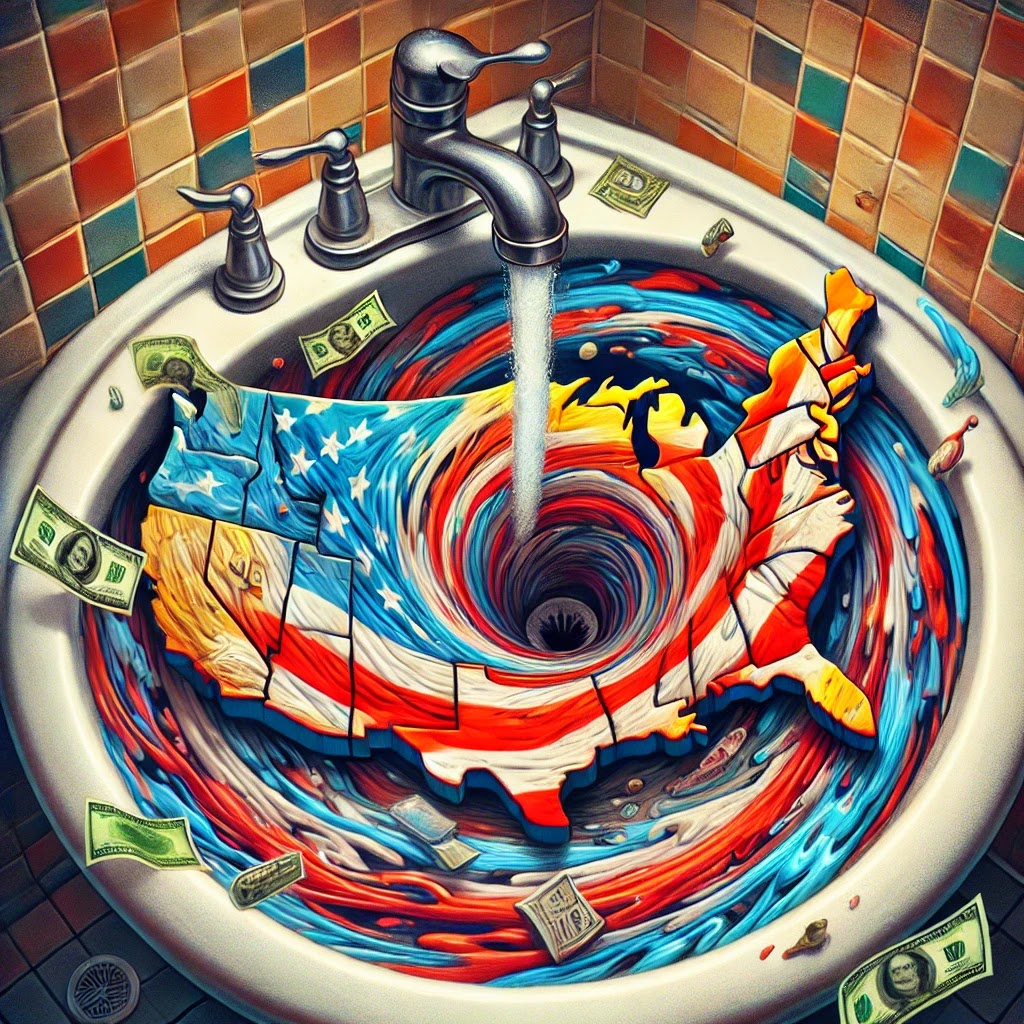
America: In Decline


There can be little doubt that the United States is in decline. We are losing ground to other countries by all measures, and it is happening faster than anyone might have imagined. In my last post, I spoke about the three pillars of power: military, economic, and infrastructure. Let's examine our status in each of these areas.

Military

We still have major dominance in this area. China is working hard to catch up, and they are deploying considerable resources to develop technological advances, but the time it takes to build the type of military power we have is making it hard for them to catch up quickly. Nonetheless, they are getting to the point where they will likely be able to hold their own in their region.

Trump is a peacenik. There has already been some talk of streamlining the military. His friends in the military-industrial complex may slow him down or even stop him, but unlike Reagan, who saw military power as a way to retain global dominance, Trump thinks he can do it through trade (we'll get to that).

This will be the last pillar of power to go due to our huge existing advantage.

Economic

Our economy is still the largest globally, but the gap is closing with China and India. They have many more people than we do, and they are leveraging their labor advantages to bring production to their countries. Furthermore, production requires natural resources. Other countries have several advantages in this area. First, China doesn't care about the governing style of leaders they negotiate with for resources. 

China is happy to offer loans to build infrastructure in exchange for extraction rights. When autocratic leaders pocket the money rather than create a functional economy that can repay the loans, China is happy to take the resources from them in exchange for loan repayment. This locks China into long-term extraction arrangements that allow it to pay with old money. The U.S. is less inclined to use such tactics, giving China a strategic advantage that is almost impossible to beat.

The U.S. under Trump encourages mining in our backyard. Even if he can overcome all of the environmental regulations that have been put in place, local resistance to destroying the landscape will likely prevail. Without resources, the plan to disadvantage countries from selling their goods here in order to force us to produce domestically is doomed to fail.

Instead, two things have already started to happen. First, producing countries are strengthening their trade relations with other trading partners and building new ones. These relationships will make them less reliant on U.S. markets, making them less likely to absorb tariffs, instead passing them on to American consumers. In so doing, they will inflate the dollar, making it less suitable as the global currency. It's just a matter of time before the dollar loses its supremacy. When that happens, we will no longer be able to print money with reckless abandon (as Trump's Big Beautiful Bill, in its current form, would do to the tune of $2.6B over the next 10 years).

Finally, immigration plays a big part in our economic decline. Much of our innovation comes from Chinese and Indian nationals who prefer to live in the U.S. As Trump makes it increasingly uncomfortable for immigrants and as their home countries get better infrastructure (more on this, too), these incredible minds will innovate elsewhere. Also, our birthrate continues to plummet, and no social engineering efforts seem likely to change that (short of forced birthing, which is underway in some states). With fewer people and less innovation, our economy will naturally shrink.

Infrastructure

While we're on the topic of immigration, who do you think builds our houses, roads, and other critical infrastructure? Many of them are immigrants. Without immigrant labor, the pace of infrastructure development will slow. Automation is and will continue to help with this. Still, Americans show a general disdain for dirty jobs, and Gen Z is looking to be the worst of the bunch for their lack of motivation to go outside in the elements and do physical labor. Just ask anyone in the building trades. They will tell you that they can't find young people to take on the apprenticeships required to learn the necessary skills. Furthermore, these may be some of the hardest jobs to automate.

The United States was the first country to have modern infrastructure--indoor plumbing and sewer systems, electrification, and interstate road systems. Because of this, our infrastructure is now the oldest. Countries playing catch-up are installing more modern systems, and because they're newer, they have yet to need maintenance. We are in the midst of replacing much of the infrastructure, and because it must connect with the old infrastructure, it is impractical to make wholesale innovations. This means countries like China and India will increasingly have cleaner, more efficient infrastructure.

As this shift happens, more people will prefer to live in those countries and the United States will become increasingly irrelevant.

Is There Hope?

It is possible that our government could magically become populated with great leaders with the vision to move us off our current trajectory. However, it would require extraordinary effort and sacrifice, something modern Americans have shown little stomach for. It is far more likely that we will get more rhetoric and blame as we circle the drain.

Tuesday, January 14, 2025

American Greatness


As a political independent, I take all political parties’ rhetoric with a grain of salt. The fight to recruit voters seems to have moved from a policy-only strategy to rhetorical psyops techniques. I refuse to be bullied or manipulated into my viewpoints. So, I read historical accounts and as much factual information as possible. One of my favorite sources is usafacts.org. It is an apolitical platform that publishes data collected by governmental programs.


The truth is under assault in this country. Finding reliable sources of data is increasingly difficult. Not only have organizations once trusted to be unbiased become politicized, but science funding has put pressure on scientists to compromise their integrity. Living in a college town, I know good scientists who care too much about their work to compromise the sanctity of the scientific method. I also hear persistent stories of more unscrupulous behavior.


Sources we once trusted for reliable data are less trustworthy. Against this backdrop of increasingly untrustworthy data sources, politicians of different parties are grooming their messaging around convenient “facts,” whether they are accurate or not. Leveraging the bad fact choices of the other side, each party can now claim that it is good and right while the other side is bad and wrong.


Many have dissected what has made America the greatest hegemony in modern history. Some historical facts stand out. First is our military power. After WWII, the US was undoubtedly the preeminent global military power. When our military-industrial complex seems out of control, we should remind ourselves of the critical nature of this leg of power.


Next comes the economy. The epicenter of the industrial revolution was in the United States. No sane person would argue against this. The economic power that ensued from this was unassailable. The US was so dominant that the dollar was the obvious choice when it came time to select an international currency for energy trading. That advantage is still with us (although there are questions about how long this situation will last).


Finally, there was infrastructure. The US was the first country with an interstate road system, rural electrification, and a national communication network. Superior infrastructure aids competitive economic and military benefits, and as an added benefit, the best and brightest minds worldwide regularly choose the US to share their talents.


Any thinking person would agree that these are the significant reasons why the United States is such a great country. The rhetoric about wokism, family values, and the right to bear arms is intended to distract from the things that matter to American greatness. It’s not that people shouldn’t have opinions about these things. It’s not a good criterion for selecting leaders. It would be as if you decided not to buy your dream home because you didn’t like the color of the realtor’s tie.


If we want to make America great again, we must return to the things that matter. Having the first great modern infrastructure means we have the oldest, and some are no longer so modern. China and India, two countries on the rise, are aggressively moving away from fossil fuels. Disregarding their effects on the environment, from a pure infrastructure standpoint, there are indisputable advantages to sustainable energy sources over the next 100-200 years. These are the timeframes in which history plays out. If we want history to show that the US remained a superpower, we need to upgrade our infrastructure to align with the future. Nobody seems to understand this better than Elon Musk, who dragged the US car market, kicking and screaming, toward a sustainable transportation future. This is something that the Left scores better on.


Next, let's look at our standing economically. We are still a superpower in this regard, but China and India are not sitting still. China does not care about what some African autocrat does with the money they offer in exchange for critical natural resources. As these countries increase their manufacturing power and access to necessary resources, it is only a matter of time before the US dollar loses its international currency standing. When this happens, we will no longer be able to print money that the global community will accept at the same value. We will need to balance our budget without the ability to print money with reckless abandon. Based on the last 50 years, it should be easy to see that will leave us a shriveled hull of the economy we once were. We need to pull our manufacturing capabilities back. The Right wins here.


This brings us to our military power—the one strength where we retain our dominance. China is the only country hoping to challenge this dominance. Nowhere is this more obvious than in the South China Sea. China’s naval power there has left us with few options to defend Taiwan effectively. Our technological advantages rest on our control of Taiwan’s chip manufacturing capabilities. Some military analysts believe we may be only a few years away from this event. Time is running out to do something to stop it (if it’s even possible at this point). This takes us back to the critical need to boost our infrastructure (in this case, the ability to build our technology here). Here, the Right wins again.


If we get these three things right, we can argue about gun laws and abortion from the luxury of our well-lit, nicely appointed homes over a tasty meal. Nobody will care about these issues if we fail because they will be worried about not freezing, boiling to death, or starving. We can’t continue to rely on the wind in our sails forever. During WWII, citizens across this great country made personal sacrifices to ensure the outcome we wanted. It is time to do so again.


Friday, August 30, 2024

You Don't Have to Hate People of Color to Be a Racist

Why are some people worried about non-white immigrants infiltrating our country? It has long been known that education and economic prosperity reduce family size. We are even starting to see this in countries like India and China, which previously were devoid of a middle class. It should come as no surprise, then, that European white people are declining in numbers faster than their counterparts in economically depressed, mostly non-white countries.


Working alongside this statistical population fact, we have a situation in which many families require two incomes to maintain the family prosperity that we’ve come to expect. Some might couch this as the result of feminism. I would argue that feminism may have made it so that women can have more opportunities for a professional career, but it did nothing to influence the fact that many women now need to work. Generally, working women don't raise large families.


While these two conditions don’t specifically target white people, it so happens that the historical privilege that white people have enjoyed globally works against them when it comes to population size. Some estimates put the global white population at approximately 16%. In an increasingly mobile world, we can expect some dispersion of the other 84% of the population. 


It’s no wonder some people have adopted The Great Replacement Theory to explain what’s happening. They think there is some cabal of neo-liberals plotting and scheming to take away the historical power that white people have enjoyed. Even if such a cabal existed, they ought to be out playing golf or something because their services are not needed for dispersion to continue.


The United States is still the greatest country on Earth. There are three main pillars of power: economic, military, and infrastructure. Arguably, our infrastructure is aging and no longer the best in the world, but two out of three is still enough to keep us in the lead.


Some argue that America is no longer great, so we need to make it great again. The facts don’t support this. These same people want to cut off the flow of immigrants. Who knows better than those attempting to emigrate here that America is still the land of opportunity? Folks, you can’t have it both ways. You can’t say we’re not great while millions fight to get here every year. 


Part of our greatness has always been the advantage of having hardworking immigrants who come here to build the life they see others here enjoying. Their creativity and willingness to take risks have brought us many, if not most, of our greatest achievements as a nation. 


Bigotry has only slowed this effect. Some white people argue that the slide from a majority will make this country worse. But if we suppress the greatness of non-white people in this country, how does that help us? It's not about the color of our skin, but the content of our character and the ideas we bring. How many ideas that make us stronger in different ways will never see the light of day because someone wasn’t given a fair chance to see their ideas blossom? We need to ensure everyone has a fair chance to contribute to our collective greatness.


Our focus on immigration should be on managing the flow of people to support our economic needs. This is not about exclusion, but about ensuring that we can provide opportunities for those who want to contribute to our society. There are many low-wage jobs in the agriculture and service industries that we simply don’t have enough people here to fill. On the other end of the economic spectrum, we have extraordinary, intelligent people worldwide who want to come here and bring their skills and expertise. Whatever color their skin, they make our country stronger for their presence. We should welcome them and make them feel like this is their home, too.


If that makes you uncomfortable, stop off at the next mirror. You are a racist!


Sunday, July 21, 2024

I Think I Finally Get MAGA


 I was born in the late 1950s. The funny thing about decades is that culturally, they don't begin and end on the oughts. The sixties we think about didn't start until the middle of the decade and didn't end until the middle of the 70s.

This meant that for the first few years of my life, I lived in the 50s. I was a kid, but I still remember the vibe. We were all taught to respect our elders, be polite in public, and stay in our lane. Lanes were important back then. If you were a woman, you had a different role in society, and while you were treated with a certain amount of respect in public, you were "just a woman."

White men ruled, and there were a lot of them. I don't think I saw a Hispanic person in Michigan until much later. Black people were poor and lived in the city. We had a semi-live-in maid whose parents were sharecroppers down South. She and her husband came North to find work in factories. Well, he did. She would not have been allowed to work in a factory then.

These rigid rules of society brought a veneer of order to public life. You knew what to expect. Even in the late 60s and early 70s, when the hippie movement took place, hippies knew they were going to be looked down upon by "the man."

As the hippies got older, they remembered that treatment and decided (some of them anyway) that it wasn't right to treat one group of people differently than others. They set about redesigning the culture so that everyone was "equal" and respect was earned, not given.

On the surface, this sounds like a move in the right direction. However, for every action, there is an equal and opposite reaction. If respect is no longer given but earned, many people won't respect others by default. Civil society, as it was called, breaks down. Instead of social rules, we have the good graces of the individual to rely on for how we're treated in public. 

To say the results of that experiment are inconsistent would be an understatement. I meet lovely, kind people when I'm out (a lot of them), and I meet people who would mow you down to get to their next destination. I try to be kind to them, too. When you're nasty in public, people will treat you equally badly, and you will form a view of the world that people are nasty. It's a vicious spiral that far too many people are caught in.

The MAGA movement (Make America Great Again, in case you didn't know) wants to roll back the clock. The goal is laudable. Bring back civil society. The approach will never work. The tensions that lay below the surface back then, when people were repressed in the name of social norms, will never be acceptable again.

MAGA as a goal is worthy, but how we get there needs to be reconsidered by those who want to put the genie back in the bottle. We have to move forward from where we are, and people are not going to go back to being unequal, repressed, or dismissed as a fringe of society.

Tactics like taking away abortion rights, removing immigrants, and eliminating programs designed to right the wrongs of our repressive past (like affirmative action) are designed to put the genie back in the bottle. 

It's time to bring back civil society without repression. I think it can be done, but we need a new approach. Maybe the MAGA folks will figure that out eventually. I live in hope.

Monday, May 27, 2024

The Civil Cold War Isn't Over


On April 9, 1865, General Robert E. Lee surrendered the Confederate Army of Northern Virginia to General Ulysses S. Grant at Appomattox Court House in Virginia. This is generally considered the end of the Civil War. As we know from history, the practices that divided us went on long after that date.

The animosity between those who advocated for the practices of the South has never fully dissipated into the sands of time. Robert E. Lee, along with other Southern leaders, were heroes to their people. While their contemporaries are long dead, their descendants carry forward their beliefs.

You might say, "They lost, we won! Get over it." Some have. Others haven't. Those who haven't still adhere to the slogan, "The South shall rise again!" Apparently, now seems as good a time as any.

It's ironic, then, that the Shenandoah County School Board in Virginia wants to restore the name of Robert E. Lee to a local school. Don't they know they are part of the North? I guess not. 

The Civil War was horrible. Any civil war pits family, friends, and neighbors against each other. There are no winners. We assume that without the Civil War, slavery would not have been abolished, but we don't know that.

Maybe the time for slavery to end was upon us in the late 1800s. Maybe had the anti-slavery movement gathered strength in another way, the outcome would have saved more lives, been more unifying, and resulted in the same eventual end to slavery.

We'll never know. In the meantime, the animosity continues to build, and nobody is doing much about assuaging it. The cold war may not stay cold forever.

Friday, May 03, 2024

We're All Going Mad!


Is it just me or are we all going crazy?


The news industry has been obliterated by social media. Now, we have no trusted sources, but those we randomly select. Pick your news and stay with it! They could be blowing smoke up your a$$, but at least it will be YOUR smoke.


A case in point is the current anti-Israel fervor on campuses across the U.S. Where are these kids getting their news? What information has made them so angry with Israel? Oh, wait! It’s simple, right?


People are dying in Gaza. The IDF is killing them. Therefore, Israel should stop. <- note the period there


If the world were only that simple. Wouldn’t it be nice if every issue just had one or two important factors? Sadly, we have so many issues facing us and every damn one of them is complex.


Once upon a time, there were people labeled Renaissance Men (they were all males -- sorry ladies and thems). The word may still be in use, but the definition has changed. These people used to know everything there was to know about human knowledge. 


Millions of people are inventing new things and ideas every day now. Nobody can be expected to keep up. We are inadequate to the task. With no universally trusted sources and growing complexity, there’s no answer in sight.


Back to our anti-Israel example. This current episode is part of a series. The kids who are protesting only watched the latest one. Their perspective is limited and narrowly focused. They need a “bad guy” to pin this human tragedy on, so they picked one -- historical perspective be damned!


Historical perspective could save us, but it’s too much work. Who wants to study the background of every issue facing us, when we can just pick a side and go with it? 


In the 1930s, the German economy was bad. People needed a fix. Along came Adolf Hitler, who blamed the whole thing on the Jews. Just get rid of them and we can go back to…oh, let’s just call it MGGA! We’ll use fear and intimidation to get everyone in line. Sound familiar? Hamas does it. Trump likes this strategy, too. 


If you’re a fan of Mazlow, you might know his hierarchy of needs: physiological, safety, love and belonging, esteem, and self-actualization (in order from base needs to the more esoteric). Note that if you threaten someone with fear and intimidation, you are messing with hard-wired reactions. It’s powerful…and effective. Despotic leaders everywhere know this.


The profile of the despotic leader throughout history is well understood. Yet, our lack of historical perspective leads us back to these people again and again. They offer us simple solutions to complex problems. Those other guys were making our heads hurt with all of their nuance. Why can’t the world go back to being simple? Maybe the slogan should be MASA (make America simple again).


Unfortunately, nobody can do that. Our puny brains can’t keep up, so we make stupid choices in the name of simplicity. 


One more case in point before I leave you, dear reader. DEI, which stands for diversity, equity, and inclusion, sounds like something everyone can get behind. Why is the social justice movement corrupt? The answer is complex, but Liberals would have you think it’s simple.


We have a history of racial discrimination in this country. Few would deny that. Those who do probably long for the “good old days” when being white meant you were special. The reality is that the vast majority of people don’t feel that way anymore. They accept that we’re all just people trying to live together.


DEI comes along and it casts our problems in racial terms. There’s a fundamental flaw with that thinking. Since the 1980s, rural America has been under attack. Agribusiness, bankers, lawyers, and insurance companies have decimated once-thriving economies. The mechanization of many jobs held by people across this country has destroyed the economies of small industrial towns.


While there are a lot of non-whites who suffer economic hardship due to the historical facts of their lineage, there are a lot of white people in the same boat for different reasons. When DEI initiatives exclude them from the party because of the color of their skin…let’s just say that it’s no surprise they want to burn the whole thing down.


Once you do the work to understand the whole picture, people’s crazy behavior starts to make sense. But that’s just too much work for most people. We just don’t have the time to keep up. So, we pick a side and hate the other one. Our technology is destroying us, and we’re helpless to stop it. Happy fucking Friday!


Sunday, December 31, 2023

It's Time to Stop Global Corporations


We are the proverbial frog -- being boiled slowly enough that we don't jump. I was on Chewy.com's website this morning, adding an item to my next auto-ship. It was so easy that I found myself scratching my head. How could Chewy get this so right, and Amazon get it so wrong?

If you've ever tried to change an Auto-ship order on Amazon, you know what I'm talking about. It's impossible to do most things (like changing the delivery address because you won't be at home), and difficult to do the few things you can do (like changing the delivery date). I know Amazon is capable of doing much better. They choose not to. These deficiencies are barriers to making their operations more complex at your expense.

This is a theme that most global corporations have figured out. They can squeeze consumers from every angle, and their sheer size and reach will cause people to just suck it up. While I'm piling on Amazon, this year, they raised their Prime cost...AGAIN! That might be reasonable, but then only a few months later, they decide to make Prime members, who expect Prime Video as one of the components of membership, pay an extra $35.88 per year to avoid ads. So, now they have added a new revenue source, AND they are making you pay extra. Sweet deal for them.

I have similar stories for every major corporation I deal with. It's the new normal. Arguably, we shouldn't blame them. It's capitalism. This is how it works. When companies go public, their very existence depends on finding new ways to increase profits. Naturally, the customer is the loser when creativity stalls.

How can we stop the bleeding? Short of ending capitalism, there's one simple change that would have a major impact -- 100% publicly funded elections. I know what you're thinking, what politician would vote for that? Answer: until we citizens demand it, none. Every politician takes money from rich people who are rich because they run corporations. It won't be easy.

Here's the thing: if elections were publicly funded, politicians would be beholden only to voters. They wouldn't be able to get rich from corporate bribes (at least legally), and they wouldn't need to spend any time listening to what corporate leaders want. This would incentivize true leaders who actually want to make positive change for the people of this country and disincentivize those who seek power and wealth.

It would essentially eliminate corporate lobby groups because their money couldn't go anywhere. Special interest lobbies would continue to exist, but politicians would be more interested in what's popular with the people than what will get them enough money to win their next election or secure a cushy life after politics.

Imagine if politicians couldn't run ads. No highly polished psyops hit pieces designed to trigger deep-seated emotions. Everything you know about them would come from position pieces, speeches, and what others say. Furthermore, nobody would ever again win an election because they outspent their opponent during the campaign.

In a democracy, the majority rules. It doesn't always work out the way people in minority positions want, but one hopes that the greater good is served. A large majority of Americans want control over assault weapons. They also overwhelmingly want the right for women to have legal abortions. Many other issues are left either unaddressed or pushed in the wrong direction by minority interests because of politicians who are working the current system. They don't need to care about the majority, so they don't.

Running publicly funded elections would be easy. Anyone filing for office would get a relatively small amount of money prior to gaining the necessary signatures to be on the ballot. If the election has a primary, candidates get a traunch of money when they get on the ballot, and another if they win the primary. 

Public funds can only be used to promote actual videos or written content by the candidate (or at least for them). Because the funding will be considerably less than what they'd receive from big donors, the Madison Avenue folks will lose interest in developing polished ads anyway. Even if they wanted to give away their services, they couldn't because that would be an illegal campaign donation.

It might take some time, but eventually, a new kind of politician would emerge. This new breed will prove very different and highly successful against the old guard who haven't embraced the new reality. The new breed will target popular issues and deliver tangible results. They will look more like "heroes of the people" and less like "backroom dealers." Greedy corporations would quickly lose favor in Washington, D.C. There's only so much time before corporate interests boil us to death. Oh, the issues we'd solve!

Tuesday, August 08, 2023

RFK Jr. - Not the Crackpot You Heard About


UPDATE: I don't get it right every time.


I confess that I have not spent much time on politics. Partially because the election is over a year away and because the two most likely candidates remind me of the movie Dumb and Dumber (I will let you decide which is which). The other day, I stumbled upon a short speech by Democratic candidate RFK Jr.


Like most of us, I’ve heard others say what a crackpot he is. They say he’s an anti-vaxxer. They say he’s anti-immigration. They say he doesn’t care about gun violence. “They” are talking for him because they are afraid that if we listen to what he’s ACTUALLY saying, we may agree with him.


The great irony is that it's a close call with Biden running against Trump. If RFK Jr. runs against Trump, it’s a landslide! Why? First, the party faithful will vote for him because they would vote for Bozo the Clown over the second coming of Jesus to support their party. So, check them off the list -- they’re not in play.


Next, you have the independent-minded folks who listen to what candidates say and make up their own minds. Most of these people know that Trump is a lying criminal who would do anything for his own self-aggrandizement. They may not love everything about RFK Jr., but at least the guy is running on the honesty platform.


Now let’s jump over to the Republican voter side of the fence (too many fences these days!). The diehard Republicans who would vote for the aforementioned Bozo notwithstanding, there are those who dislike Trump but know he will protect their gun rights. Guess what? So will RFK Jr.!  RFK Jr. also wants to build Trump’s wall. He’s a big proponent of closing the border.


Finally, RFK Jr. wants to stop big pharma from getting away with running the various health and regulatory agencies that are supposed to be keeping them in check in the name of public safety. If that’s being an anti-vaxxer, then I’m one too! He just wants people to have reliable, well-tested drugs. Seems like a reasonable ask.


I like RFK Jr. for the same reason I liked John McCain (I would have voted for him had his party not jammed Palin down his throat). He was not afraid to stand up against his own party when they weren’t acting in the best interests of the broader population of the American people. Like McCain before him, many people speak for RFK Jr. They will tell what he’s all about, so you don’t have to listen to him. They don’t want you to listen to him. They are afraid you might like what you hear.


Listen to him yourself. Think about why we are so divided right now, and ask yourself if he’s the guy that might bring us back together and…dare I say it…make America great again. One caution before you listen to him: you’ll hear him say things that sound counterfactual. Don’t take my word for it, but I have done my own research -- he is the one telling the truth.

Monday, June 26, 2023

Suckers!


Last year I wrote a post about Hate. Since then, I have seen the situation get worse. Our two political parties, I will call them A and B for my purposes, have found the secret weapon to keep us divided. And people are piling on! The secret weapon is hate. 

I'm reminded of Dr. Seus' Butter Battle Book, a Cold War parable. In it, you see the signs of hate manifesting. While our differences are less trivial than how we butter our bread, the techniques are the same. We pick a side. It doesn't matter which one. We call the other side our enemy. We must defeat them!

The A party wants to ban books. The B party wants children to read whatever they want. These narratives are designed to divide. The likely reality is that no sane parent wants their child to read whatever they want. How do we best go about ensuring that our children read books that are age appropriate? Banning them from schools and libraries is one way.

What people believe and what our political leaders tell us they believe are not the same. You will not know this unless you talk with people with different beliefs. Our leaders don't want you to do that. The starker they can make our differences, the more hate they will foment. 

We generally don't talk with people we hate. We do talk with people who have differing viewpoints. If political leaders keep us from talking with one another, they control the narrative. That's just what they want! Meanwhile, life is not getting better for most of us. They're not doing anything about it, and as long as we don't talk with each other, we're not helping either.

We lose -- they win! Suckers!

Sunday, February 12, 2023

Dysmis Information

Throughout human history, breakthroughs and social advancements have led to great upheaval. We seem to be in such a moment in history now For millennia, humans communicated primarily via word-of-mouth. News from other parts of the world were virtually non-existent. A common language didn't even exist if travelers were able to physically show up. Then came writing, then the printing press, radio, TV and finally the internet.

Up until the internet, all forms of disseminating information had one thing in common -- a relatively small group of people got to decide what information was shared, how it was shared, and to whom. If we trusted those sources, everything felt right with the system. If we didn't, there were few choices to spread our concerns about the veracity of the information being shared.

The internet changed all that. Now, we all have a voice. If that wasn't enough, we've added artificial intelligence to the mix. We can only imagine the secrets that have been kept from the masses over the course of human history because it was so easy to keep them. Now, it is almost impossible to keep secrets. Once more than a few people know a secret, it gets much easier to spread it because the source of the "leak" will be hard to ascertain.

Secret-keepers need new tools to combat leaks. Mis & dys information are those tools. Hidden among all the completely made up stories about would-be events and activities are actual secrets that have been leaked out. Of course, just as anyone can make a claim about "the true story," others can claim its falsehood. Good luck sorting out the mess. The whole idea here is that you can't.

Case in point: there is a pervasive claim that the U.S. has bioweapons labs in the Ukraine. In an attempt to search for "the truth," here's what I was able to uncover.

  1. China and Russia both claim they have evidence of the U.S. facilities and are seeking an investigation
  2. I was unable to find any evidence that U.S. officials would welcome such an investigation (which you'd think they'd want if the allegations were false)
  3. U.S. based scientists agree that there are U.S. funded bio-research facilities in the Ukraine (but not for weapons research)
  4. U.S. officials categorically deny the existence of said labs
  5. Some speculate that Russian accusations about bioweapons is a pretense to prepare their own bioweapon attack (because bioweapons are illegal by global treaty, so someone has to break the treaty first)
  6. The Russians have repeatedly used bioweapons or sanctioned their use (such as in Syria), whereas there is no record of such usage by the U.S.
These "facts" leave only speculation about the two possibilities: 1) the U.S. does have secret bioweapons labs in the Ukraine and is covering it up by denial, or 2) the Russians have manufactured this story for their own purposes. To date, I was unable to find any actual hard evidence of a U.S. lab. If such facilities did exist, secrecy and security would be at a maximum, so hard evidence would be unlikely.

A small number of people know the real truth. Too bad we have no way to distinguish the liars from the truthers. We will each choose to believe what we want. Our leaders use this ambiguity to divide us. They tell us which of these stories is true, but of course only one of them can be true and that means the others are lying. Maybe they know it or maybe they don't. It's all a big mess.

If we're all going to get along, we need to stop being manipulated by the people we trust. We must learn to live with the ambiguity of not really knowing and demand hard evidence before we declare something factual. The absence of evidence isn't enough. Sadly, it's usually near impossible to disprove a negative. So, if there are no U.S. bioweapons labs in the Ukraine, nobody will ever find evidence that there is, but just because we don't have evidence doesn't prove that they don't exist. It's a conundrum. Those usually suck and this time is no exception.

My advice to you, dear reader, is be skeptical and open-minded. When somebody tells you something that you "don't believe," take a beat to recognize that you're debating over beliefs -- not facts. Acknowledge possibilities and spread skepticism. Only through this widespread practice can "we, the people" start demanding real hard evidence for claims, because as long as leaders can manipulate us with conjecture, they own us.