Search This Blog

Showing posts with label #government. Show all posts

Thursday, March 05, 2026

We Live in the Age of Well-Crafted Narratives


a cartoon of a zombie watching a social media feed on their laptop.
As the world changes, smart and powerful people see the big picture quicker than the rest of us. They have more access to information than we regular folks do, and they are surrounded by other smart people with greater knowledge.

It stands to reason, even without specific evidence, that these people will use their power and influence to shape general behavior in ways that benefit them.

So, what does that look like?

The first question we need to ask is, where do most people get their information about the world around them? Once upon a time, it was the TV network news. Raise your hand if that's your primary source of news now. What? Nobody? Yup, that's our new reality.

For some, it's Facebook, Instagram, or TikTok. For others, it's YouTube. What do all of these platforms have in common? Go ahead and take a minute. It will come to you. Did you guess? It's the algorithm.

Let's unpack the algorithm. This is a complex set of rules that is applied to your feed. These rules determine what you see, and more importantly, what you don't see.

When you first join a social media network, the content you see in your feed is whatever is the most popular. The thinking of the algorithm designers is that if a lot of people liked it, then you will too. Of course, your tastes are unique, so some popular stuff won't appeal. When you click on or interact with the content you do like, the algorithm takes note and begins building a profile.

That profile becomes a feedback loop. Even though you may have many broad interests, once the feedback loop kicks in, unless you actively search for specific content, it keeps strengthening.

Eventually, your information bubble becomes impenetrable. Your searches for specific content have little weight in the feedback loop unless you NEVER click on anything in your feed, which is hard to do because you are interested in what's there.

This is bad, but it is not what concerns me most. I am more concerned about the inability to access unpopular content. This is critical because much of the best content is not the sensationalized garbage designed to grab your attention.

The rich and powerful people who control these platforms are guiding the rules governing their algorithms. We might assume they are focused solely on attention to better monetize their platform, but we don't know that.

Algorithms are a black box, and they control our view of the world. This should be untenable. The government should demand that the algorithms be open-source and completely transparent. A few politicians are calling this out, but many (most?) of them are complicit. The black box serves them, too.

It's like asking politicians to vote for public financing of elections. They will never do it because they are the victims of that change.

Being able to craft a narrative and have hundreds or even thousands of different people amplify it is so powerful that nobody in control will ever willingly give it up.

I have recently started posting on Bluesky. It is the only social media platform that lets you control what appears in your feed — 100%. Their algorithm is simply to present the content I choose to include. Ironically, they are the least popular of all of the social media platforms. Why? They are not manipulating you into the attention trap.

If all the other platforms are energy drinks, Bluesky is water. It's the best thing for us, but it's not an easy choice. Where this leads, I can only guess, but democracy relies on a well-informed public, and that ain't happening.

Wednesday, June 04, 2025

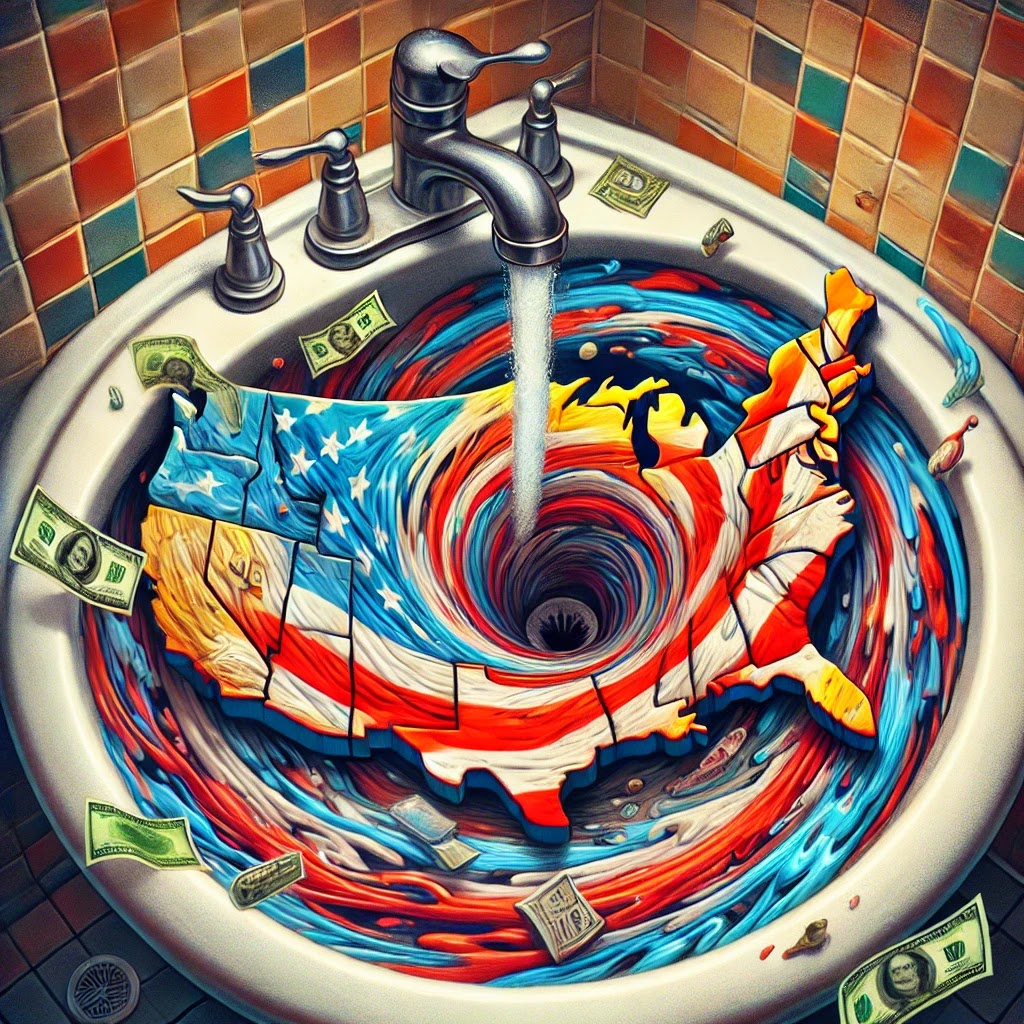
America: In Decline


There can be little doubt that the United States is in decline. We are losing ground to other countries by all measures, and it is happening faster than anyone might have imagined. In my last post, I spoke about the three pillars of power: military, economic, and infrastructure. Let's examine our status in each of these areas.

Military

We still have major dominance in this area. China is working hard to catch up, and they are deploying considerable resources to develop technological advances, but the time it takes to build the type of military power we have is making it hard for them to catch up quickly. Nonetheless, they are getting to the point where they will likely be able to hold their own in their region.

Trump is a peacenik. There has already been some talk of streamlining the military. His friends in the military-industrial complex may slow him down or even stop him, but unlike Reagan, who saw military power as a way to retain global dominance, Trump thinks he can do it through trade (we'll get to that).

This will be the last pillar of power to go due to our huge existing advantage.

Economic

Our economy is still the largest globally, but the gap is closing with China and India. They have many more people than we do, and they are leveraging their labor advantages to bring production to their countries. Furthermore, production requires natural resources. Other countries have several advantages in this area. First, China doesn't care about the governing style of leaders they negotiate with for resources. 

China is happy to offer loans to build infrastructure in exchange for extraction rights. When autocratic leaders pocket the money rather than create a functional economy that can repay the loans, China is happy to take the resources from them in exchange for loan repayment. This locks China into long-term extraction arrangements that allow it to pay with old money. The U.S. is less inclined to use such tactics, giving China a strategic advantage that is almost impossible to beat.

The U.S. under Trump encourages mining in our backyard. Even if he can overcome all of the environmental regulations that have been put in place, local resistance to destroying the landscape will likely prevail. Without resources, the plan to disadvantage countries from selling their goods here in order to force us to produce domestically is doomed to fail.

Instead, two things have already started to happen. First, producing countries are strengthening their trade relations with other trading partners and building new ones. These relationships will make them less reliant on U.S. markets, making them less likely to absorb tariffs, instead passing them on to American consumers. In so doing, they will inflate the dollar, making it less suitable as the global currency. It's just a matter of time before the dollar loses its supremacy. When that happens, we will no longer be able to print money with reckless abandon (as Trump's Big Beautiful Bill, in its current form, would do to the tune of $2.6B over the next 10 years).

Finally, immigration plays a big part in our economic decline. Much of our innovation comes from Chinese and Indian nationals who prefer to live in the U.S. As Trump makes it increasingly uncomfortable for immigrants and as their home countries get better infrastructure (more on this, too), these incredible minds will innovate elsewhere. Also, our birthrate continues to plummet, and no social engineering efforts seem likely to change that (short of forced birthing, which is underway in some states). With fewer people and less innovation, our economy will naturally shrink.

Infrastructure

While we're on the topic of immigration, who do you think builds our houses, roads, and other critical infrastructure? Many of them are immigrants. Without immigrant labor, the pace of infrastructure development will slow. Automation is and will continue to help with this. Still, Americans show a general disdain for dirty jobs, and Gen Z is looking to be the worst of the bunch for their lack of motivation to go outside in the elements and do physical labor. Just ask anyone in the building trades. They will tell you that they can't find young people to take on the apprenticeships required to learn the necessary skills. Furthermore, these may be some of the hardest jobs to automate.

The United States was the first country to have modern infrastructure--indoor plumbing and sewer systems, electrification, and interstate road systems. Because of this, our infrastructure is now the oldest. Countries playing catch-up are installing more modern systems, and because they're newer, they have yet to need maintenance. We are in the midst of replacing much of the infrastructure, and because it must connect with the old infrastructure, it is impractical to make wholesale innovations. This means countries like China and India will increasingly have cleaner, more efficient infrastructure.

As this shift happens, more people will prefer to live in those countries and the United States will become increasingly irrelevant.

Is There Hope?

It is possible that our government could magically become populated with great leaders with the vision to move us off our current trajectory. However, it would require extraordinary effort and sacrifice, something modern Americans have shown little stomach for. It is far more likely that we will get more rhetoric and blame as we circle the drain.

Tuesday, January 14, 2025

American Greatness


As a political independent, I take all political parties’ rhetoric with a grain of salt. The fight to recruit voters seems to have moved from a policy-only strategy to rhetorical psyops techniques. I refuse to be bullied or manipulated into my viewpoints. So, I read historical accounts and as much factual information as possible. One of my favorite sources is usafacts.org. It is an apolitical platform that publishes data collected by governmental programs.


The truth is under assault in this country. Finding reliable sources of data is increasingly difficult. Not only have organizations once trusted to be unbiased become politicized, but science funding has put pressure on scientists to compromise their integrity. Living in a college town, I know good scientists who care too much about their work to compromise the sanctity of the scientific method. I also hear persistent stories of more unscrupulous behavior.


Sources we once trusted for reliable data are less trustworthy. Against this backdrop of increasingly untrustworthy data sources, politicians of different parties are grooming their messaging around convenient “facts,” whether they are accurate or not. Leveraging the bad fact choices of the other side, each party can now claim that it is good and right while the other side is bad and wrong.


Many have dissected what has made America the greatest hegemony in modern history. Some historical facts stand out. First is our military power. After WWII, the US was undoubtedly the preeminent global military power. When our military-industrial complex seems out of control, we should remind ourselves of the critical nature of this leg of power.


Next comes the economy. The epicenter of the industrial revolution was in the United States. No sane person would argue against this. The economic power that ensued from this was unassailable. The US was so dominant that the dollar was the obvious choice when it came time to select an international currency for energy trading. That advantage is still with us (although there are questions about how long this situation will last).


Finally, there was infrastructure. The US was the first country with an interstate road system, rural electrification, and a national communication network. Superior infrastructure aids competitive economic and military benefits, and as an added benefit, the best and brightest minds worldwide regularly choose the US to share their talents.


Any thinking person would agree that these are the significant reasons why the United States is such a great country. The rhetoric about wokism, family values, and the right to bear arms is intended to distract from the things that matter to American greatness. It’s not that people shouldn’t have opinions about these things. It’s not a good criterion for selecting leaders. It would be as if you decided not to buy your dream home because you didn’t like the color of the realtor’s tie.


If we want to make America great again, we must return to the things that matter. Having the first great modern infrastructure means we have the oldest, and some are no longer so modern. China and India, two countries on the rise, are aggressively moving away from fossil fuels. Disregarding their effects on the environment, from a pure infrastructure standpoint, there are indisputable advantages to sustainable energy sources over the next 100-200 years. These are the timeframes in which history plays out. If we want history to show that the US remained a superpower, we need to upgrade our infrastructure to align with the future. Nobody seems to understand this better than Elon Musk, who dragged the US car market, kicking and screaming, toward a sustainable transportation future. This is something that the Left scores better on.


Next, let's look at our standing economically. We are still a superpower in this regard, but China and India are not sitting still. China does not care about what some African autocrat does with the money they offer in exchange for critical natural resources. As these countries increase their manufacturing power and access to necessary resources, it is only a matter of time before the US dollar loses its international currency standing. When this happens, we will no longer be able to print money that the global community will accept at the same value. We will need to balance our budget without the ability to print money with reckless abandon. Based on the last 50 years, it should be easy to see that will leave us a shriveled hull of the economy we once were. We need to pull our manufacturing capabilities back. The Right wins here.


This brings us to our military power—the one strength where we retain our dominance. China is the only country hoping to challenge this dominance. Nowhere is this more obvious than in the South China Sea. China’s naval power there has left us with few options to defend Taiwan effectively. Our technological advantages rest on our control of Taiwan’s chip manufacturing capabilities. Some military analysts believe we may be only a few years away from this event. Time is running out to do something to stop it (if it’s even possible at this point). This takes us back to the critical need to boost our infrastructure (in this case, the ability to build our technology here). Here, the Right wins again.


If we get these three things right, we can argue about gun laws and abortion from the luxury of our well-lit, nicely appointed homes over a tasty meal. Nobody will care about these issues if we fail because they will be worried about not freezing, boiling to death, or starving. We can’t continue to rely on the wind in our sails forever. During WWII, citizens across this great country made personal sacrifices to ensure the outcome we wanted. It is time to do so again.


Monday, May 27, 2024

The Civil Cold War Isn't Over


On April 9, 1865, General Robert E. Lee surrendered the Confederate Army of Northern Virginia to General Ulysses S. Grant at Appomattox Court House in Virginia. This is generally considered the end of the Civil War. As we know from history, the practices that divided us went on long after that date.

The animosity between those who advocated for the practices of the South has never fully dissipated into the sands of time. Robert E. Lee, along with other Southern leaders, were heroes to their people. While their contemporaries are long dead, their descendants carry forward their beliefs.

You might say, "They lost, we won! Get over it." Some have. Others haven't. Those who haven't still adhere to the slogan, "The South shall rise again!" Apparently, now seems as good a time as any.

It's ironic, then, that the Shenandoah County School Board in Virginia wants to restore the name of Robert E. Lee to a local school. Don't they know they are part of the North? I guess not. 

The Civil War was horrible. Any civil war pits family, friends, and neighbors against each other. There are no winners. We assume that without the Civil War, slavery would not have been abolished, but we don't know that.

Maybe the time for slavery to end was upon us in the late 1800s. Maybe had the anti-slavery movement gathered strength in another way, the outcome would have saved more lives, been more unifying, and resulted in the same eventual end to slavery.

We'll never know. In the meantime, the animosity continues to build, and nobody is doing much about assuaging it. The cold war may not stay cold forever.